

The browser has quietly become the riskiest application in the enterprise tech stack. Employees work, share, and co‑create with AI from inside a browser that was never designed for enterprise‑grade security or data loss prevention. Attackers know that a single malicious script or credential theft in that environment can route around even the most mature SSE, EDR, and DLP programs.
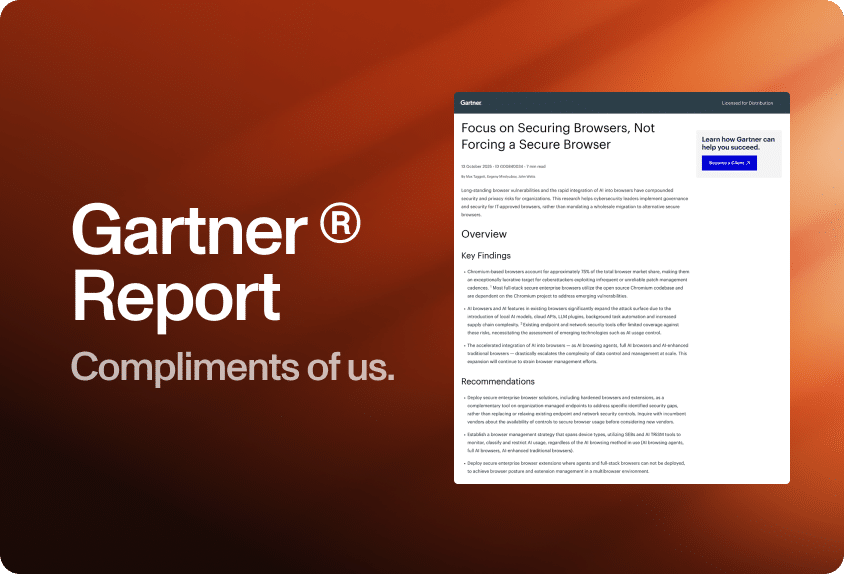
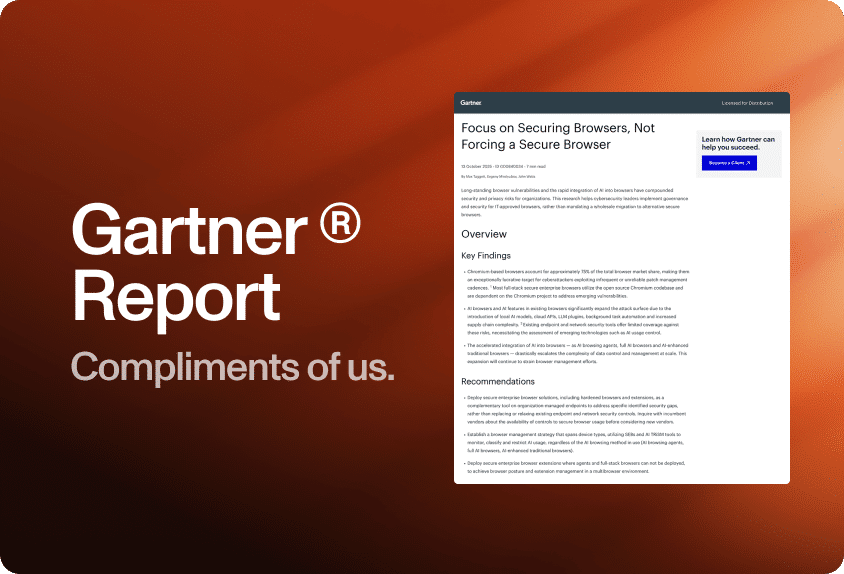
The new analyst report by Gartner®, “Focus on Securing Browsers, Not Forcing a Secure Browser,” underscores this shift and validates what many CISOs are already experiencing: the real problem is not which browser your users choose, but how you secure all of them in an AI‑driven world.
“Chromium-based browsers account for approximately 75% of the total browser market share, making them an exceptionally lucrative target for cyberattackers exploiting infrequent or unreliable patch management cadences.” – Gartner
What we think Gartner says is really changing
In our opinion, the core message by Gartner is that long‑standing browser vulnerabilities plus rapid AI integration have created a new class of security and privacy risk that traditional network and endpoint tools do not adequately address. Instead of attempting a wholesale migration to a single “secure browser,” Gartner recommends deploying secure enterprise browser solutions, including hardened browsers and extensions, as a complementary tool on organization-managed endpoints to address specific identified security gaps, rather than replacing or relaxing existing endpoint and network security controls.
The report highlights secure enterprise browsers (SEBs) as critical controls to close “in‑session” gaps such as malicious extensions, drive‑by exploits, and zero‑day vulnerabilities, while stressing that SEBs must integrate deeply with the broader security stack and cannot be treated as standalone silver bullets. Gartner also emphasizes that AI browsers and AI features inside mainstream browsers drastically expand the attack surface and urges security leaders to adopt AI TRiSM‑style controls to monitor and restrict AI usage directly in the browser, where prompts and responses actually live.
Standout stat: Gartner notes that zero‑day patches for Chromium can take 24–72 hours to land in full‑stack enterprise browsers. This is an exposure window that attackers can and do exploit.
Why forcing a dedicated browser fails in practice
To us, A key nuance in the report is the distinction between when to use full‑stack enterprise browsers and when to rely on secure browser extensions. Forcing a dedicated enterprise browser makes sense only in tightly scoped use cases such as “clean room” workspaces, access for third‑party endpoints, and others. Outside those contexts, Gartner is blunt: most organizations have never been able to dictate a single browser for productivity or security reasons.
“Over the past few decades, most organizations have not been able to dictate a single browser for productivity or security reasons. The emergence of secure enterprise browsers does not change this reality. With the release of the Comet browser from Perplexity and other AI vendors announcing their own integrated AI browsers, end users are likely to want more, not fewer, browsers to improve work productivity. – Gartner
That reality creates a structural problem for vendors whose model depends on switching users into a dedicated enterprise browser. If security is bound to a special browser, any user activity that stays in Chrome, Edge, Safari, or an emerging AI browser falls outside your policy and telemetry. This creates a split‑brain security posture that is hardest to manage precisely where risk is growing fastest.
Gartner captures this trade‑off directly by recommending secure enterprise browser extensions to expand reach and “minimize the attack surface across multiple browsers,” especially when there is no organizational mandate to restrict browser choice.
How we believe Seraphic aligns with the Gartner blueprint
We believe Seraphic’s approach was built around the exact challenges Gartner calls out: diverse browser environments, AI‑driven workflows, and the need to treat SEBs as complementary controls that integrate with the rest of the security stack. Rather than compelling users to adopt a new browser, Seraphic turns any traditional or AI browser into a secure enterprise browser through a lightweight agent that operates at the browser’s JavaScript engine layer.
This architecture gives CISOs several advantages that map directly to Gartner’s evaluation criteria. Seraphic enforces inline data loss prevention (DLP) in the browser itself, controlling uploads, downloads, clipboard, screenshots, printing, and screen sharing, without the latency penalties of routing traffic through proxies. It also brings behavioral controls and exploit prevention directly into the browser runtime, enabling threat detection in the precise execution path Gartner flags as a priority.
Seraphic’s customer feedback reflects this alignment.
“Seraphic enables Waste Management to adopt a ‘Bring Your Own Browser’ approach, ensuring enterprise-grade security without compromising workforce convenience.” – Jerich Beason, CISO at WM
“Seraphic is a key component of our ZTNA and has retained a 100% phishing detection rate.” – Petri Ala-Annala, CISO at Nobia.
We believe that this combination of coverage, user choice, and measurable effectiveness is exactly what Gartner urges buyers to validate when they evaluate secure enterprise browser controls.
Securing the AI browser without breaking workflows
Gartner dedicates a significant portion of the report to AI, noting that AI browsers, AI‑enhanced traditional browsers, and autonomous AI browsing agents create entirely new risks – from prompt injection and jailbreaking to opaque data flows across plugins, local models, and cloud APIs. The authors stress that secure enterprise browsers should provide ways to inspect GenAI prompts and responses in clear text and apply intent‑aware policies, without breaking encryption or relying solely on network‑level inspection.
Seraphic’s AI browser security capabilities were designed with this scenario in mind. Because Seraphic runs inside the browser runtime, it can monitor and control how users and AI tools interact with SaaS applications, private data, and identity providers. Seraphic’s GenAI dashboard provides visibility into which AI tools are used, what data they touch, and which actions occur. Its AI access control lets security teams define granular policies for which AI tools are allowed, what data can be shared, and how sensitive content is masked, watermarked, or blocked in real time.
Actionable next steps for CISOs
A browser‑native platform like Seraphic can help you:
- Build a browser security strategy, not a browser standardization project: Treat secure enterprise browsers and extensions as complementary controls; avoid long, disruptive migrations to dedicated enterprise browsers except for narrow, high‑value use cases.
- Prioritize in‑browser DLP and AI controls: Focus on investment in inline browser controls that can inspect and govern uploads, downloads, clipboard, screen capture, and AI interactions without breaking user workflows or HTTPS.
- Extend protection to every browser and device: Use a single agent‑based approach to cover managed endpoints, BYOD, contractors, and AI browsers so that data loss prevention and threat detection policies follow the user—not a specific browser.
- Evaluate vendors using Gartner’s questions: Ask how solutions monitor malicious extensions, protect JavaScript engine & WebAssembly, resist tampering, and integrate with your SIEM, SOAR, SSE, and EDR stack.
Final Thoughts
For security leaders who recognize that the “enterprise browser” is no longer a product, but a security posture that must apply to every browser and every AI experience, Seraphic offers a future‑ready path: turn the browsers your users already love into enterprise browsers.
To dive deeper into the Gartner analysis, read the full licensed Gartner report, “Focus on Securing Browsers, Not Forcing a Secure Browser,” available complementary by Seraphic.
Gartner, Focus on Securing Browsers, Not Forcing a Secure Browser, 13 October 2025, Max Taggett Et Al.
GARTNER is a trademark of Gartner, Inc. and/or its affiliates.
About the Author